


Have you ever been asked, “Why won’t the incumbent just build this?”
For every product I’ve built, I’ve been asked this one 100% of the time.
I mean, don’t incumbents have a lot more money, a lot more pull, and a much bigger team to get it done? And it IS scary and annoying to know that the giant could just eat you up.
But plenty of companies have been built despite the giants. A lot of them ended up getting acquired by those same giants, and some became giants themselves.
So how can you tell if the giant actually wants to build your idea, or if it’s safe from them?
A founder asked me this exact question recently. Here’s what I told them.
They Won’t Build Everything Their Users Want
Let’s take Substack as an example. I’m not sure it has fully earned incumbent status yet, but for paid newsletter writers, it’s the giant in the room.
On July 30, Michelle Songy posted a Note about the “is Substack dying?” panic.
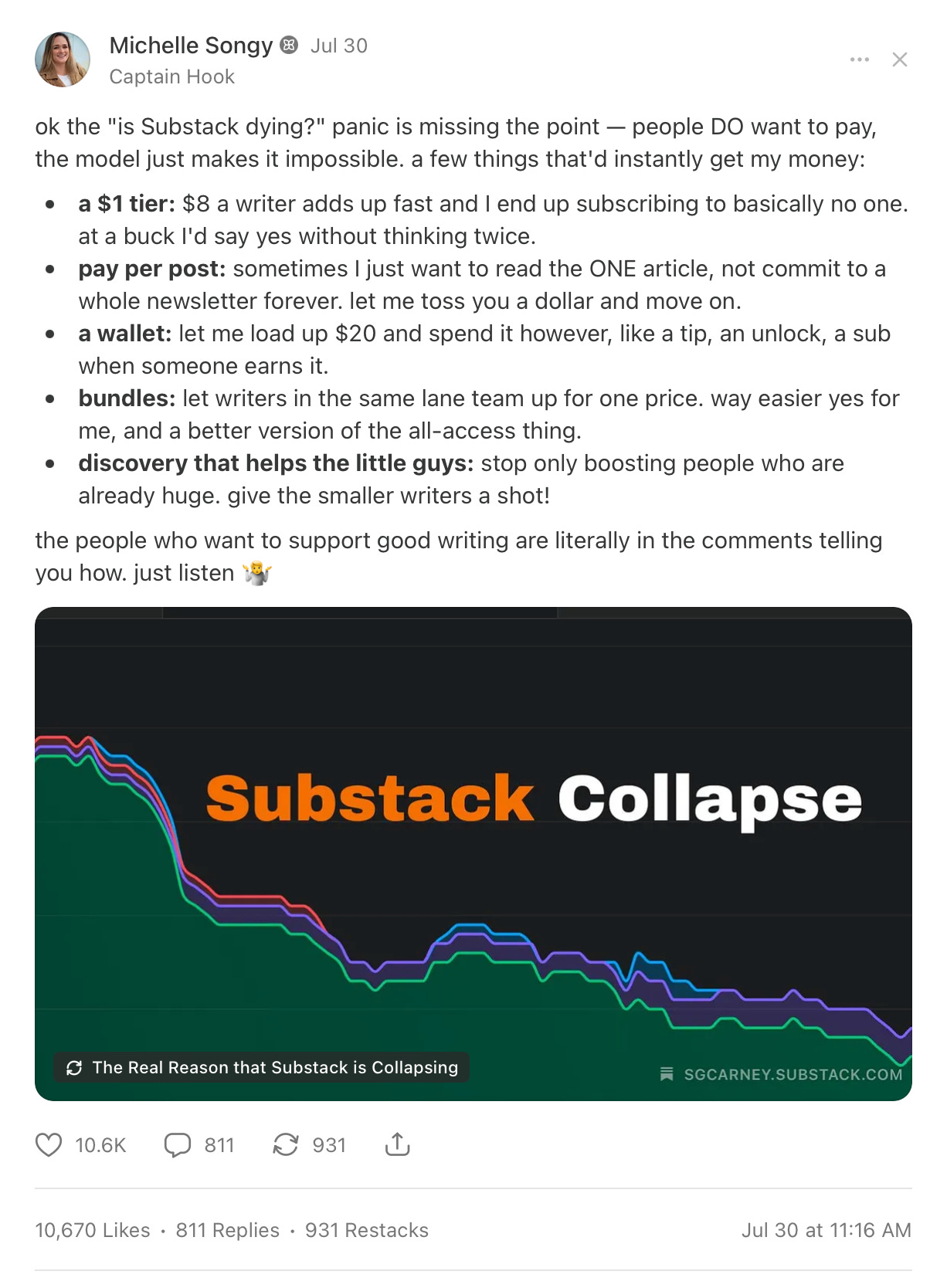
She argued that readers do want to pay, but Substack’s model just makes it hard.
It got 10,000+ likes and around 800 replies.
Eight weeks earlier, a writer named Robert M. Hamburger had published an open letter to Chris Best asking Substack to not become what they wanted to replace. That one got more than 1400 comments.
And I read EVERY REPLY on both posts. Just kidding, obviously I asked Claude to read them and summarize for me.
But some of the ideas in those threads were genuinely good! Cheaper ways to pay, a feed that doesn’t bury long essays, small fixes that would make everyday writers and readers use Substack more.
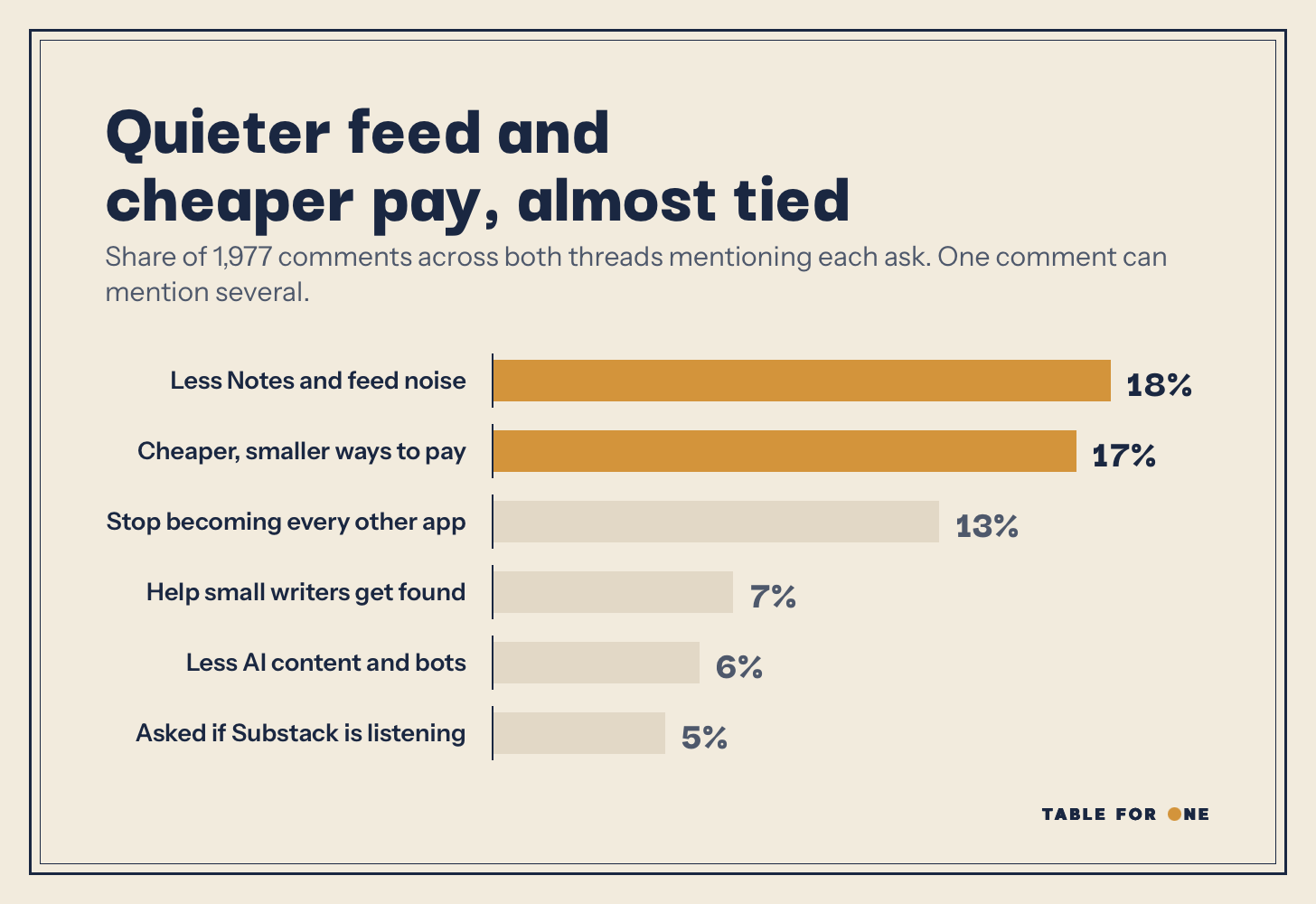
But will Substack build all of them? Nope.
Should you build a product that has those features? Well… It depends.
Three Kinds Of Gaps
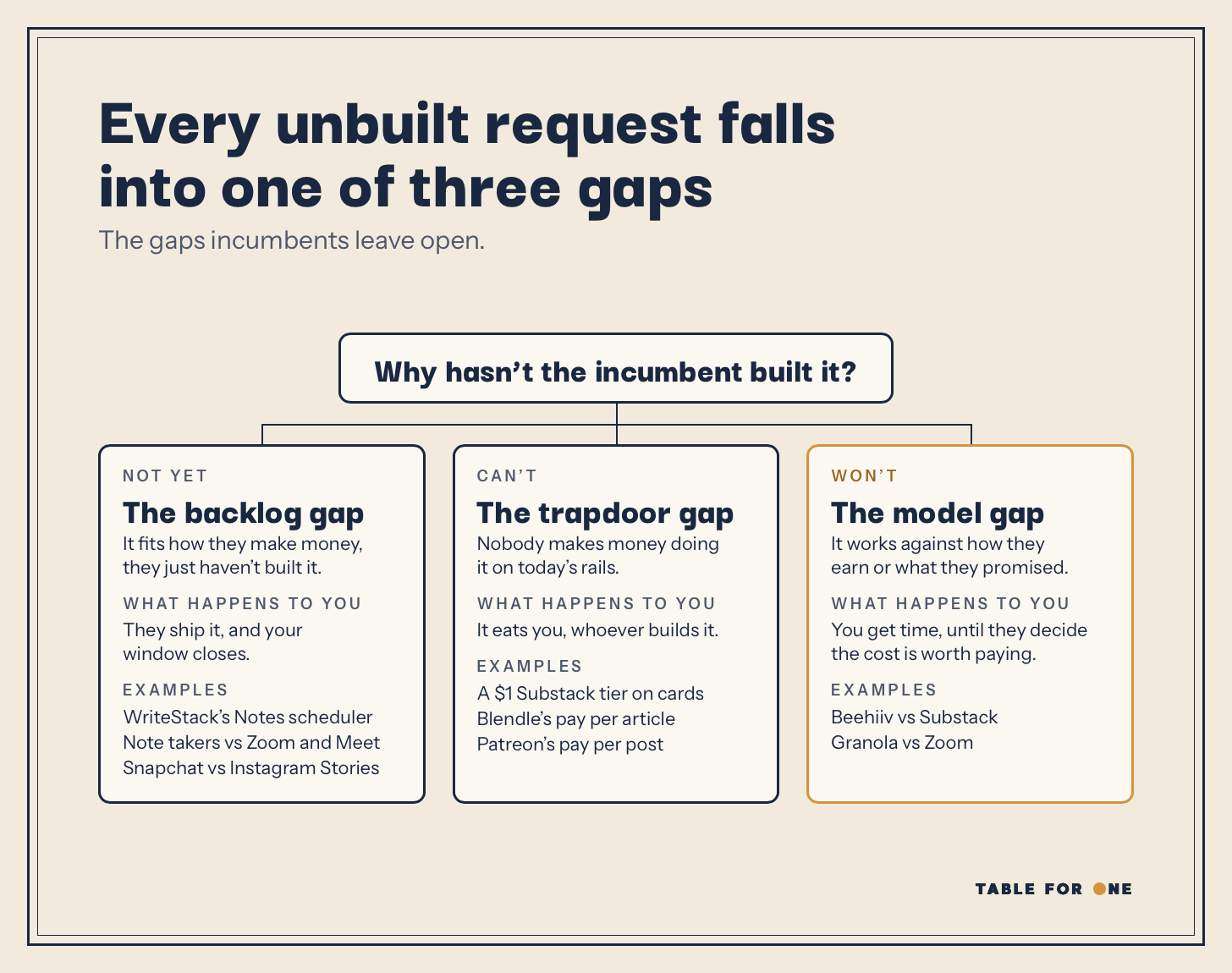
When an incumbent leaves something unbuilt, it is usually for one of 3 reasons.
It simply isn’t a priority right now
They can’t make money doing it
Building it would hurt the business they already have
1. The Backlog Gap
A backlog gap is something the incumbent hasn’t built yet but has every reason to. It makes the product stickier, even if it doesn’t bring in more revenue, so it’s on the list somewhere and one day it will ship.
And if you build a company in that gap, you might get a lovely few years or (maybe just a few days). But your time is limited.
Orel Zilberman’s WriteStack is the perfect example.
WriteStack lets Substackers schedule their notes. And it genuinely wild to image that Substack did not have this feature. But when they finally launched it, WriteStack’s core product feature became completely redundant overnight.
Zoom and Google did the same thing to standalone note takers like Otter. Zoom added AI meeting summaries for paying customers in September 2023. Google added “take notes for me” to Meet the following August. Both moves made Otter completely redundant.
So how do you know if your idea is sitting in someone’s backlog?
Follow the product!
If the feature makes the incumbent’s product stickier or brings in more revenue, that feature is going to get built. No matter how long it’s been on the wishlist.
You can also look at what they’ve shipped this year. If their launch posts, changelogs and job listings keep landing closer to your idea, know that it’s coming.
2. The Trapdoor Gap
A trapdoor gap is something that the incumbent can’t fill. Users want it, the demand is supposedly loud, but nobody can make money doing it.
One of the biggest asks on Michelle Songy’s post was the $1 tier. And as interesting as it sounds, it just won’t work for anyone.
Let me explain.
Substack’s minimum paid price is $5 a month. Every card payment through Stripe takes 2.9% + $0.30 + 0.7% recurring fee.
So on a $5 subscription, the writer gets $4.02, Stripe gets $0.48, and Substack gets $0.50.
On a $1 subscription, the writer gets $0.56, Stripe gets $0.34, and Substack gets $0.10.
The business model simply does not work!
And no… you can’t just drop Stripe to solve the problem. Most of the $0.30 goes to the bank.
Blendle, a Dutch online news platform, tried a micro payments model. They let their readers pay $0.19 to $0.49 per article from a wallet. They had over a million users, but only about 150,000 of them ever paid. When they sold their company in 2020 (6 years after launch), they were still not profitable. They finally shut the micro payments model in 2023.
And it’s not just about micro-payments. Remember MoviePass? In 2017, they launched their $9.95 a month pass. With this pass people could watch a movie every single day. And everyone LOVED it. MoviePass hit nearly 3 million subscribers.
But it was paying theaters close to full ticket price every time someone went, so every extra movie someone watched cost MoviePass a lot more money.
By the summer of 2018, it was losing about $21 million a month, and it shut down in September 2019.
If your idea is a cheaper version of something with the same business model, you need to rethink it.
3. The Model Gap
A model gap is something the incumbent won’t build. Because building it would go against the business the incumbent already has or the promise it made to its customers.
Three people from Morning Brew started Beehiiv in 2021. And they built pretty much the opposite of Substack: no feed, a flat monthly fee and 0% of your subscriptions. Substack didn’t copy that because it makes its money from a 10% cut of subscriptions and Substack is betting its whole valuation on the feed.
Adding AI Notes to WriteStack was a brilliant move by Orel! Because this feature sits in Substack’s model gap. Substack’s founders have been against AI slop in posts, and the recent partnership with Pangram proves it. So building a feature that writes your Notes for you would break the promise Substack just made to its readers.
Zoom will never take notes on your Google Meet calls. Granola built a note taker that works across them all.
Blockbuster made insane money from late fees (approx. $800 million in 2000). So they would never build a rental business without late fees.
The best place to build is in the model gap.
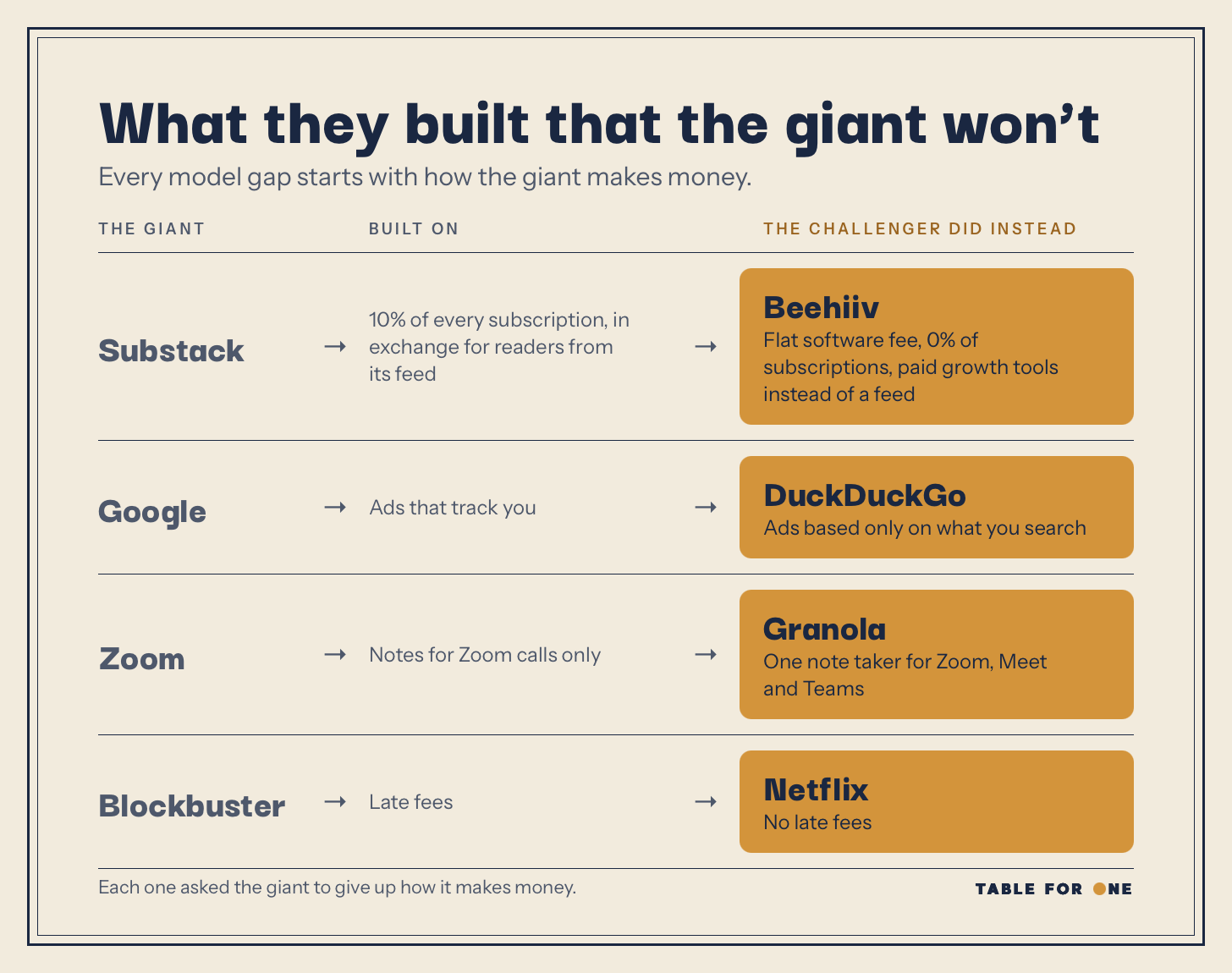
To spot the gap, look for the things incumbents almost never do. They don’t kill their own biggest revenue line, they don’t make a competitor’s product better, and they don’t break a promise their customers rely on.
If your idea needs them to do one of those, you’re in the PERFECT place!
So the next time someone asks “why the incumbent won’t build this?”
Don’t panic! And please don’t say “they are too slow to move at the pace of a startup.”
That is a very weak argument.
Try to figure out where you land.
And if you are building something in an industry with an incumbent, I would love to know which gap your startup sits in. Tell me in the comments!
Hey !
Thank you for being a subscriber to Table for One. If you are a solo founder, join us!