


I ALWAYS overengineer what I build.
When I launched Sprintt, a platform to help early-stage founders get their first 100 users, I got 178 people to use the app and finish step 1.
The app could do a lot of things for you like run research, help you post on Reddit, track your user interviews, monitor competitors and a few other things. It was so convoluted and annoying to understand that only a handful of the people came back the second time.


I’ve built around 5 apps up until now, and every time, it ends up becoming an overcomplicated version of what I wanted to solve. That just pushes back the day I get it in front of the users.
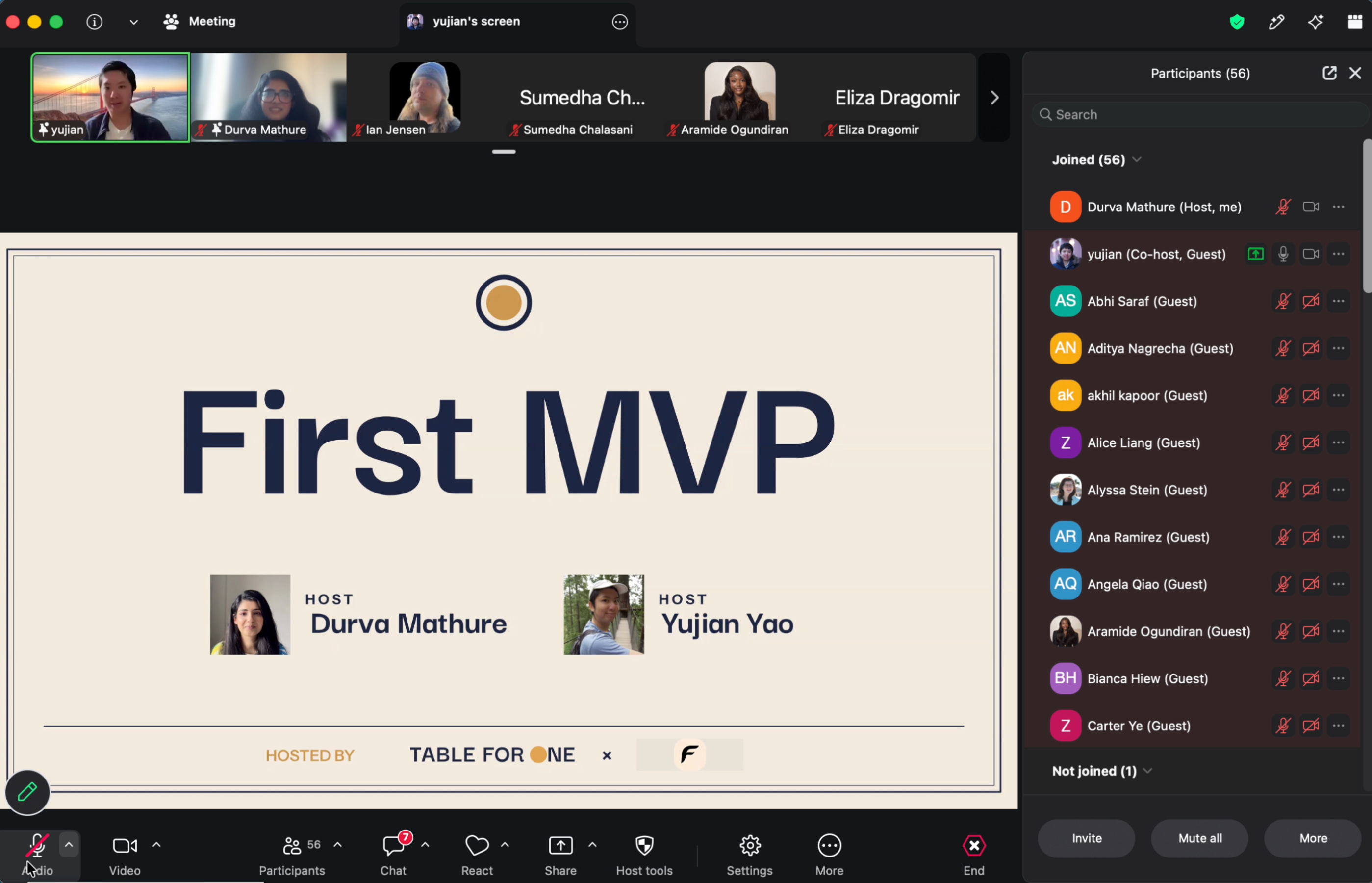
So last Thursday, in the middle of SF Tech Week, I had a lot of people like me on a call with Yujian Yao, the co-founder and CEO of Floot (YC S25). He spent an hour helping all of us figure out what exactly the first MVP should be. This is what I learned from him.
Would You Use This?
If you’re building a product, you should be building something that you want. Yujian’s reason was simple, “because there are people like you.” You’re your own customer, so the feedback loop is a lot faster.
So if you’re the user, just figure out a flow according to how you use things and how you make decisions, and viola you have your MVP.
I didn’t do this with Shezaar. I hate scrolling through an app to find an outfit that I like. I usually shop whenever I need something specific. And one of the earliest versions of Shezaar was an app where you could find the products.
I was fixated on building an app for two reasons. A lot of the people I consulted at the time told me it was the better option. And a lot of my competitors had apps, apps that I could see problems in.
This is what I’m doing now (and I think the sixth time is the charm).
I’m building a meal planning app, and it’s supposed to be a very extensive app eventually, but right now it just does the one thing I could not find from others on the market. It helps you actually prep for the meals so on the day you only spend 15-20 mins cooking. Meal prepping is a thing I do every Sunday and cannot use a claude project to do it anymore.
Sell before you build
It’s not always that we’re building for ourselves. Sometimes we’re building for a completely different industry, because it’s a problem that we observed. In that situation, the first thing you need to do is sell before you build anything.
Not groundbreaking advice. But you’d be surprised how difficult it is to actually follow this.
When vibe coding was not this could, you would make something in Figma to show to your users, to see if they would be willing to pay for it. Today you can whip up a prototype within a day or two.
But the logic still remains the same.
“If people are just like, oh, that’s cool, that’s not what you want to hear.” - Yujian
You need someone to actually commit. Actually use it and come back tomorrow.
Find The Delight
A founder friend of mine had told me she was building a minimum lovable product, and Yujian echoed the same logic.
“We like to use the word minimum viable product. But another way to think about that is, what is a minimum delightful product? Meaning if you show this one to someone else, would they be delighted? Your product can be absolutely crappy everywhere. But one or two of the features will bring a lot of delight to these potential users.” - Yujian
What they mean by delight, or lovable, is that there’s a moment when you’re using a product that makes you want to come back to it again. Think through the apps and the tools that you use today. I can guarantee that anything you use repeatedly has given you that moment.
So based on what you’re trying to solve, what would that moment of delight be? Find it, show it to your users, and map your entire MVP around that moment. Yujian said that with vibe coding you can even build out 5 things at the same time and test all 5 to see which one gives the most delight.
Build To Learn
Your MVP is not the final thing.
99% of the time, it won’t be the final version of the product that you end up launching to the broader market.
The only purpose of your MVP should be to test whether your hypotheses are true. That’s it.
When Yujian was saying this, it was an instant light bulb for me. I was always overcomplicating things because I was building every MVP as if it was the final product.
The first version of Shezaar was overbuilt to work as a full marketplace, including a backend for the brands, which wasn’t necessary at the time.
So your MVP doesn’t need to be polished. It doesn't need to be complete. It just has to be complete enough to let you learn from your users.
“It’s never going to be ready. There’s always going to be bugs. It’s always going to look ugly, but that’s okay. Your goal is to learn and iterate and to find out what is the point of delight.” - Yujian
This came up in my discussion with Rebecca Spitzer too. Because it’s so easy to build anything right now, people are just in 100% build mode. It’s very fun to see your ideas materialize in front of you. It’s definitely not fun to talk to users, and it’s extremely scary to get your product in front of people. So you open the project in the evening to add one more feature or redo the UI of your Home Screen. While you have barely shared this with anyone who would want to use it.
But Is Your MVP Good?
Yujian kept calling his first version crappy, so I asked him how polished it actually was when he shared it.
It wasn’t even Floot yet. It was a design system tool. It had the basics like authentication, and one flow he had tested enough to demo the value. He showed it to people in his community and he realized that nobody wanted a design system tool.
But he saw that people were using it to build multi-page apps and e-commerce stores.
“People were really excited even though I know it’s crappy. And they were almost abusing it to do what Floot is doing today, instead of what I intended with the whole design thing.” - Yujian
That was his first signal. The thing people were abusing it for is what Floot is now.
The second signal came later. Floot was free, but with a quota. When you ran out, you had to talk to him to get more, which was still free.
“Some people actually started to tell us like, hey, how should I pay for this?” - Yujian
So he says to charge the user as soon as you can, “because that filters out the people who are really there for fun.”
He also said a part of it was luck.
“I could have thrown something out there and nobody cared.” - Yujian
But nobody caring is a signal too. With Sprintt, 178 people finished step 1 and only a handful came back.
Before you open your project again this week, pick the one flow that should delight someone and stop building everything else until a real person has used it.
I hope this article gave you some clarity on your scoping and building your MVP. If you have any questions, drop it in the comments below!